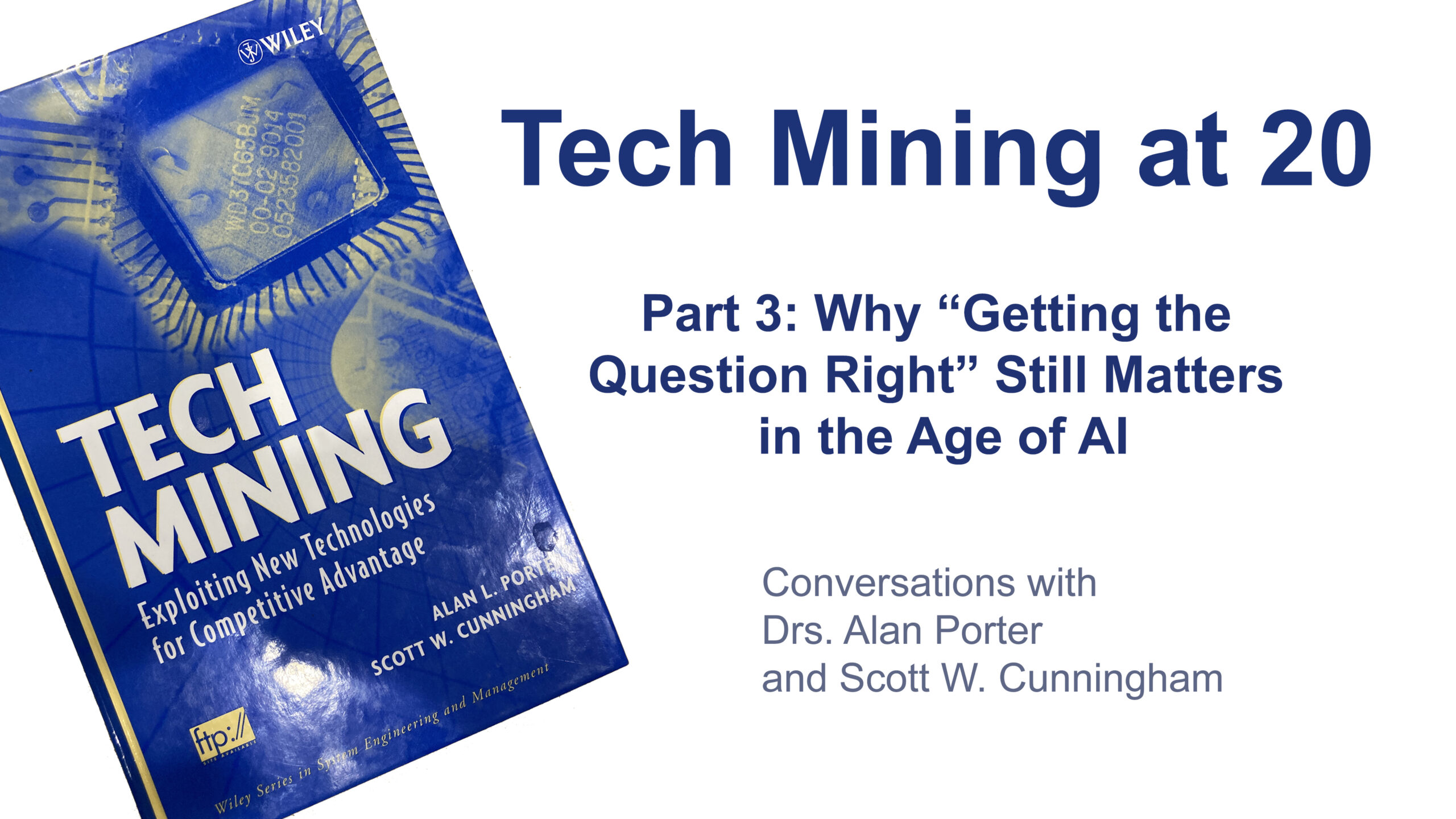
In a recent retrospective, Search Technology’s Nils Newman sat down with Alan Porter and Dr. Scott Cunningham, the authors of the seminal 2005 text Tech Mining: Exploiting New Technologies for Competitive Intelligence.
In part one, we explored rethinking R&D and the Tech Mining Adoption Gap. In part two, the conversation shifted to being compelling and precise in the age of AI. Be sure to watch those videos on our YouTube channel if you haven’t already.
In the latest installment of our retrospective series on the 2005 landmark book Tech Mining, authors Scott Cunningham and Alan Porter discuss a fundamental shift in competitive intelligence: how the rise of AI-driven natural language processing is transforming the fundamental way we frame research questions and search for data.
The Death of Boolean?
The conversation began with a stark observation: Boolean logic—once the backbone of information retrieval—is becoming foreign to the next generation of researchers. As AI models like BERT and their successors have ushered in an era of natural language search, the rigid, syntax-heavy queries of the past are being superseded by systems that intuitively grasp user intent.
Integrating Syntax and Semantics
While the tools for searching have evolved, the challenge of “getting the question right” remains paramount. For decades, text mining treated syntax (structure) and semantics (meaning) as two separate, often conflicting domains. Today’s AI models are collapsing that divide.
“Now, semantics and syntax are all together, all at once, in a mysterious way inside those networks,” Scott explained. “Boolean is not going to be enough… I really think there’s a thing coming up where we’re going to look at these structures in the argumentation of science, and we’re going to be able to mine them better.”
The transition to natural language search represents a “really interesting opportunity,” but it requires a fundamental shift in how we think about language itself, and the authors warn against over-relying on the “magic” of AI to do the work for us. The new frontier isn’t just about throwing natural language at a database; it’s about looking deeper into the structures of documenting science.
The Path Forward: Mining Argumentation
The goal of tech mining remains constant—extracting meaningful insights from vast datasets—but our approach must become more sophisticated. The authors suggest that moving beyond simple term variations is essential. Instead, we should focus on:
- Subject-Action-Object (SAO) Framing: Identifying the core mechanics within patent and research language to understand exactly “what” is happening to “what.”
- The Argumentation of Science: Moving toward mining the “rules, modes, shoulds, and oughts” of innovation to predict technological trajectories.
The Constant Target in a Changing Tech Stack
As the authors concluded, we are currently confronting a more pragmatic, structural understanding of how we communicate. The next generation of tech mining won’t just search for keywords; it will map the underlying logic of scientific and technical advancement. While the “how” has changed—moving from SQL databases to data lakes and from Principal Component Analysis (PCA) to Transformers—the “what” remains remarkably stable: finding the “nugget” of insight.
Next up in Tech Mining at 20, part four … Tech Mining & AI: New Models and Tools