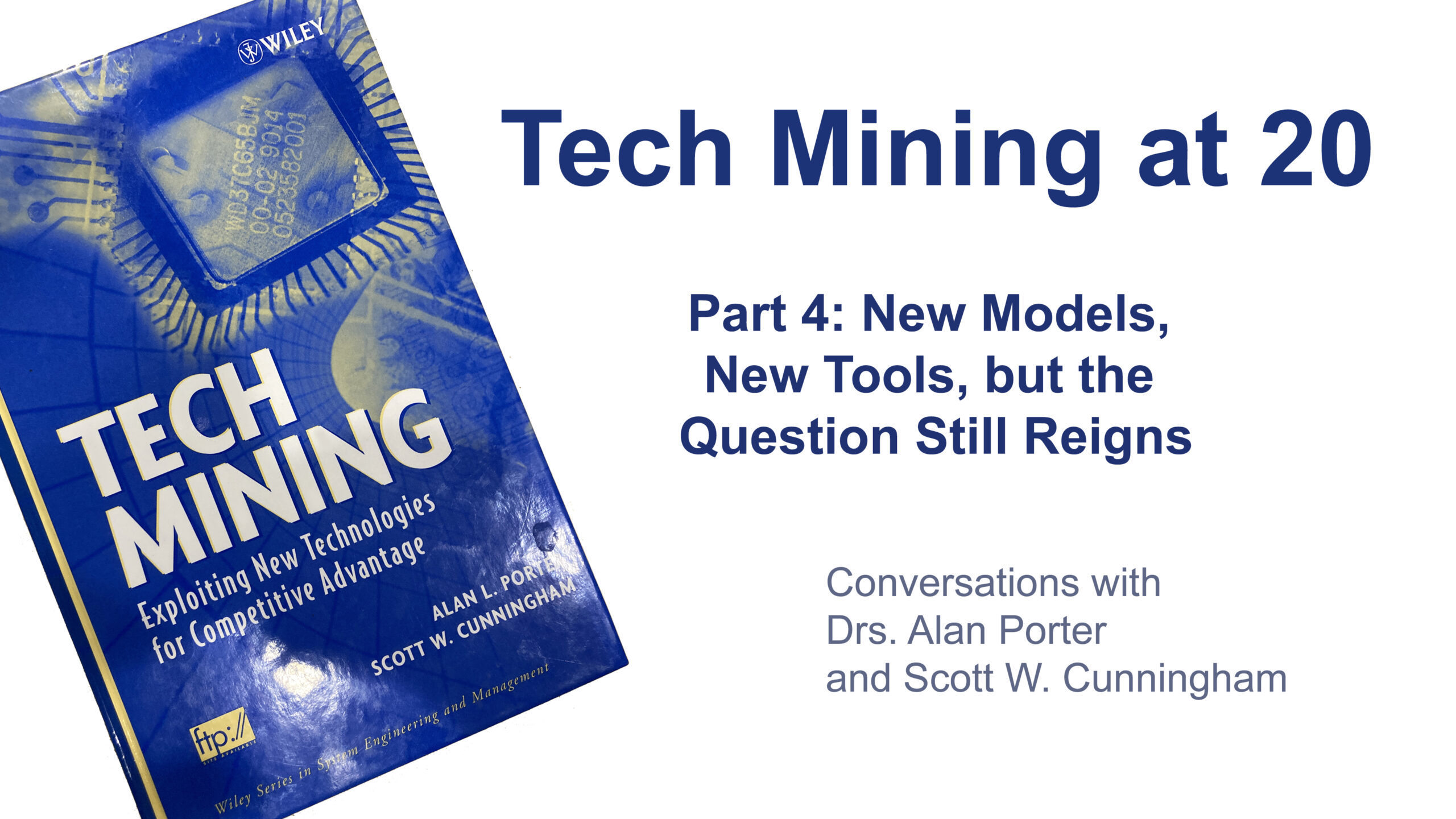
We’ve reached the final episode in our retrospective with Dr. Alan Porter and Dr. Scott Cunningham, the authors of the seminal 2005 text Tech Mining: Exploiting New Technologies for Competitive Intelligence.
If you missed the other episodes, you can find them on our YouTube channel:
Part 1: Rethinking R&D and the Tech Mining Gap
Part 2: Beyond the Dashboard: Being Compelling and Precise in the Age of AI
Part 3: Why “Getting the Question Right” Still Matters in the Age of AI
In the final installment of our conversation, we turn our focus toward the future. As Generative AI (GenAI) reshapes the competitive intelligence landscape, the authors discuss the evolution from 100-term Boolean queries to the potential of “medium-weight” models—reminding us that while tools evolve, the art of inquiry remains the core of tech mining.
The Double-Edged Sword of Generative AI
While GenAI offers a more intuitive way to synthesize complex data, that ease of use comes with a significant risk: “hallucinations” or errors could undermine the credibility of the entire field.
“I could imagine we hit something where generative AI contributed substantially to some summation on the status of an emerging technology, and it’s wrong,” Alan noted. “We really have to pay serious attention to checking and reviewing so we don’t get the ‘oh, we relied on the AI, and we had a horrible blunder with terrible consequences. Therefore, stop using AI.’”
For tech mining to remain a viable tool for decision-makers, the transition to AI must be accompanied by a rigorous culture of validation. The goal remains getting “useful, usable intelligence,” but the route has become more precarious.
As Scott puts it, “we need to be vigilant… What are the tests that would show that this is validated knowledge?”
Beyond Linear Models: Seek Explainability with “Medium-Weight” AI
Traditional tech mining tools—like factor and cluster analysis—which often provide just “additional slices” of the same data, have limitations. The true power of AI lies in its ability to capture the non-linear, compounded structures of science that previous models couldn’t reach.
However, Scott envisions future models that offer a “midway” between simple clustering and the “black box” of LLMs. He ponders, “it’s not unimaginable that medium-weight things with [tens or hundreds of thousands] of parameters might give us really good common models of science and technology that we could use… midway models that do some of the things that tech mining does, but are not so strange or incomprehensible as these large language models.”
The “Rewrite”: Literacy, Open Source, and Reusability
When asked how they would update Tech Mining for today’s landscape, both authors emphasized the need for a new kind of literacy. It isn’t just about being a software engineer; it’s about knowing how to interact with AI models to produce reproducible, actionable results.
Key updates to the Tech Mining framework would include:
- Open-Source Integration: A shift toward open-source programming to democratize access to advanced analytical tools.
- Reproducible Templates: Moving away from custom-made, one-off analyses toward “queries or templates that you could prompt whenever addressing a new technology.”
- Internal Validation: Developing specific tests to see how a model might fail before the analysis begins.
The Bottom Line: The Question Still Reigns
Despite the radical shift in tools and computational power, the fundamental core of tech mining remains unchanged. Whether you are writing a 100-term Boolean string or prompting a medium-weight AI model, the value of the output is entirely dependent on the quality of the inquiry.
As Scott puts it, the future of the field lies in finding the “right questions that we ought to be asking about these models.” In the age of AI, machines can provide answers, but only humans can provide intent.