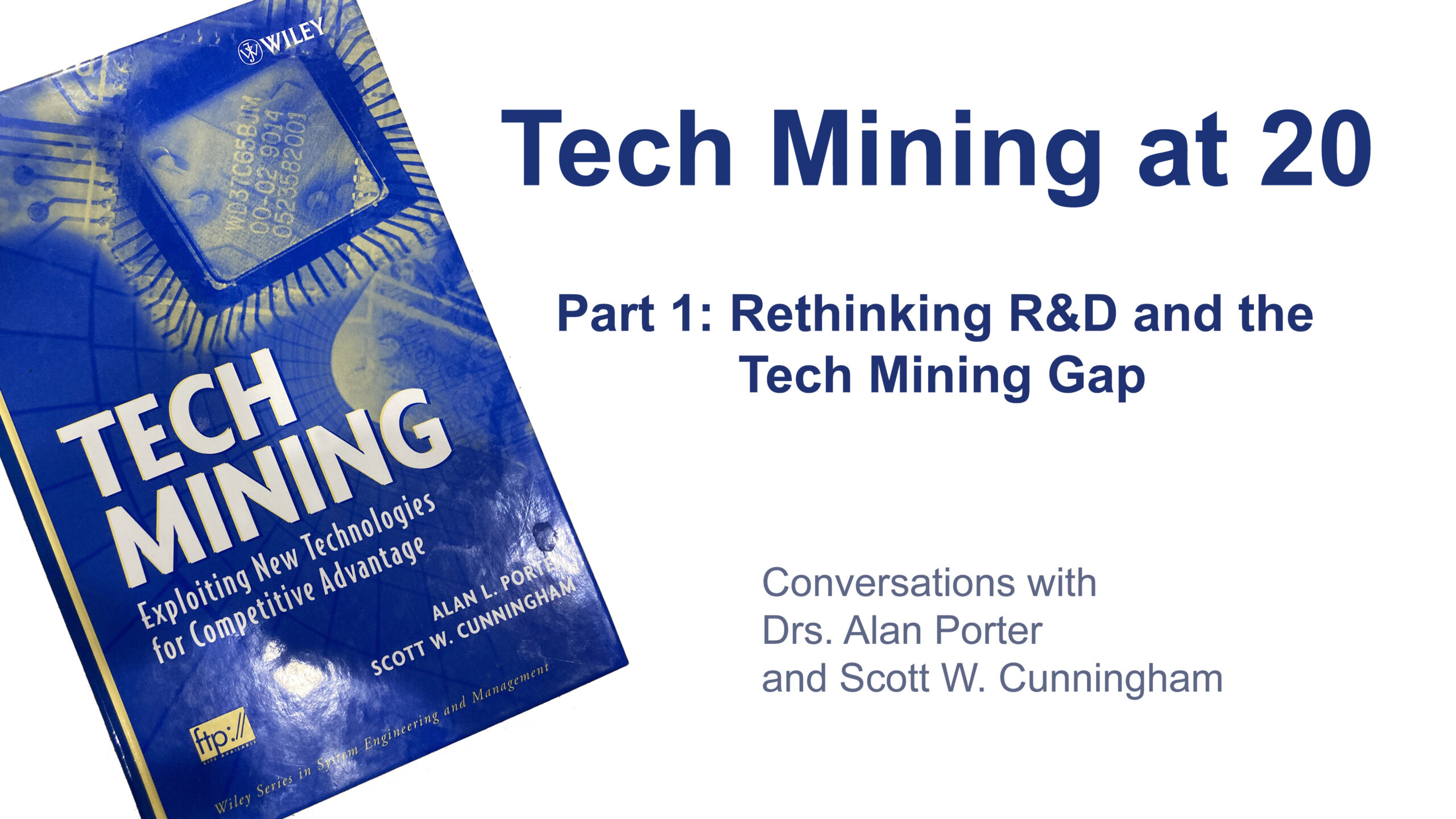
The seminal book in the text analytics field, Tech Mining, has turned 20 years old, and much has changed — and stayed the same — since its release. We recently sat down with the book’s authors, the distinguished Dr. Alan Porter and Dr. Scott W. Cunningham, to revisit the book’s foundational concepts, its impact, and the future of Tech Mining in the age of AI. We have broken the ranging interview into a four-part series, “20+ Years of Tech Mining: Bridging Timeless Fundamentals and AI Innovation.”
In part one, we explore rethinking R&D and the Tech Mining Adoption Gap. Be sure to watch the video above for a more in-depth discussion, but here are the highlights.
Are We Outgrowing the “Chain Link” R&D Model?
The “Chain-Link” model of innovation—introduced by Kline and Rosenberg—offered us a framework to connect technology push and market pull, shaping our thinking for decades. However, as the research landscape shifts toward complex, interdisciplinary science, many of us are questioning its limits. Are these models still sufficient to explain how innovation happens today?
Scott challenges the staying power of these traditional frameworks:
“I’m skeptical about some of these grand old thinkers that we used there in the beginning. Particular that chain-link model. It was a real inspiration for me because I did the technology push and market pull and put them into a single framework. But the statement is that knowledge basic research runs alongside production processes and that the locus of innovation is in single farms. And I think we collectively need to know more about that.”
He adds that today’s reality requires a more comprehensive lens:
“We’ve got science-based innovation now, like pharmaceuticals. We’ve also got whole national systems of recombining technologies, a whole vocabulary of different technology domains, and how they’re coming together. And I think we need a richer picture.”
Why aren’t bench scientists using these quantitative evaluation methods? And how to fix it.
One of the biggest hurdles we face in Tech Mining is the hesitation of bench scientists and researchers to adopt the very tools designed to help them.
Alan points to a lack of clear infrastructure and role definition:
“I think lack of familiarity with the tools is one of the starting issues to be overcome, and probably some lack of clarity as to who’s responsible for what. In terms of the competitive intelligence needed to reflect on where we’re headed in particular technologies and make those bench decisions.”
Scott offers another perspective: the nature of the data itself. Bench scientists hold massive amounts of information that never actually make it into the databases we use for mining:
“They probably have a lot of tacit knowledge to the things that they know probably aren’t getting out into the database. So that says, well, could there be a way of tapping into this tacit knowledge inside firms?”
As we look toward the future, how do we fix this adoption gap? First, we need to leverage AI to make these information resources far more accessible. As Alan notes:
“I think AI tools, one of their roles, may be to make the information resources more accessible. If we can make that happen…”
Second, we need to bridge the gap between data miners and the people on the front lines of discovery. Scott believes the solution lies in a collaborative approach:
“Maybe it’s co-teaming people and tech mining have to come together to create a richer picture.”
Innovation isn’t just about the data we mine; it’s about the people who create the data and how we empower them to use it. Are we mining the future of innovation, or are we simply building elaborate maps of where it has already been? Are we engaging the “tacit knowledge” locked inside the heads of bench scientists?
Coming up in Tech Mining at 20 part two … Is your data compelling enough to lead to action?